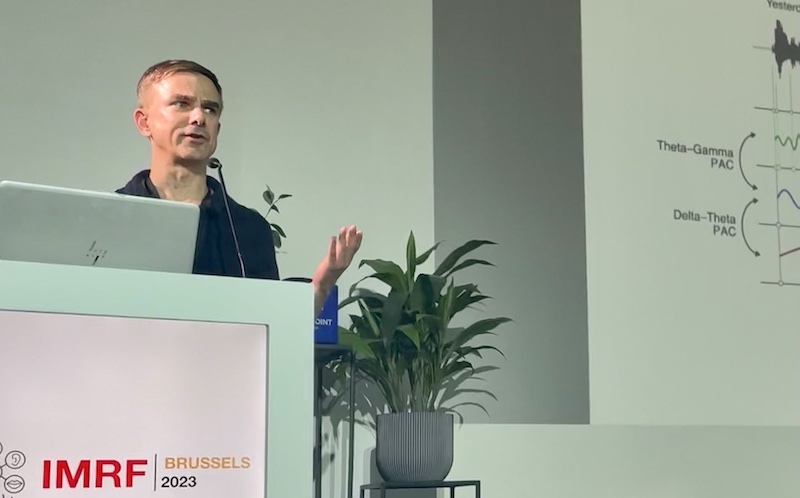
I am a Professor of Clinical Neuropsychology in the Department of Psychiatry and Neurosciences at Charité Berlin. I lecture, supervise neuropsychological assessments, treat patients, and lead the Multisensory Integration Research Group.
@PubMed @GScholar @LinkedIn @X @Bluesky
 Academic background
 Grants as Principle Investigator
Grants as Co-Investigator
 Awards
 Teaching
Selected articles:

 Multisensory integration
Senkowski D, Engel AK. 2024. Multi-timescale neural dynamics for multisensory integration. Nature Reviews Neuroscience. 25:625-642. (📥)
Michail G, Senkowski D, Niedeggen M, Keil J. 2021. Memory load alters perception-related oscillations during multisensory integration. Journal of Neuroscience. 41:1505-1515. (📥)
Keil J, Senkowski D. 2018. Neural oscillations orchestrate multisensory processing. Neuroscientist. 6:609-626. (📥)
Balz J, Keil J, Roa Romero Y, Mekle R, Schubert F, Aydin S, Ittermann B, …, Senkowski D. 2016. GABA concentration in superior temporal sulcus predicts gamma power and perception in the sound-induced flash illusion. Neuroimage. 125:724-730. (📥)
Talsma D, Senkowski D, Soto-Faraco S, Woldorff MG. 2010. The multifaceted interplay between attention and multisensory integration. Trends in Cognitive Sciences. 14:400-410. (📥)
Senkowski D, Schneider TR, Foxe JJ, Engel AK. 2008. Crossmodal binding through neural coherence: implications for multisensory processing. Trends in Neurosciences. 8:401-409. (📥)
 Neural signatures of schizophrenia
Moran JK and Senkowski D. 2025. Intersensory attention deficits in schizophrenia relate to ongoing sensorimotor beta oscillations. Schizophrenia 19. (📥)
Senkowski D and Moran JK. 2022. Early evoked brain activity underlies auditory and audiovisual speech recognition deficits in schizophrenia. Neuroimage:Clinical. 33, 102909. (📥)
Moran JK, Keil J, Masurovsky A, Gutwinski S, Montag C, Senkowski D. 2021. Multisensory processing can compensate for top-down attention deficits in schizophrenia. Cerebral Cortex. 31:5536-5548. (📥)
Moran JK, Michail G, Heinz A, Keil J, Senkowski D. 2019. Long-Range Temporal Correlations in Resting State Beta Oscillations are Reduced in Schizophrenia. Frontiers in Psychiatry. 10:517. (📥)
Roa Romero Y, Keil J, Balz J, Gallinat J, Senkowski D. 2016. Reduced frontal theta oscillations indicate altered crossmodal prediction error processing in schizophrenia. Journal of Neurophysiology. 116:1396-1407. (📥)
Senkowski D, Gallinat J. 2015. Dysfunctional prefrontal gamma-band oscillations reflect working memory and other cognitive deficits in schizophrenia. Biological Psychiatry. 77:1010-1019. (📥)
⚡Crossmodal processing of pain
Senkowski D, Heinz A. 2016. Chronic pain and distorted body image: Implications for multisensory feedback interventions. Neuroscience Biobehavioral Reviews. 69:252-259. (📥)
Senkowski D, Höfle M, Engel AK. 2014. Crossmodal shaping of pain: a multisensory approach to nociception. Trends in Cognitive Sciences. 18:319-327. (📥)
Höfle M, Hauck M, Engel AK, Senkowski D. 2012. Viewing a needle pricking a hand that you perceive as yours enhances unpleasantness of pain. Pain. 153:1074-1081. (📥) (Press release & Scientific American podcast)
Senkowski D, Kautz J, Hauck M, Zimmermann R, Engel AK. 2011 Emotional facial expressions modulate pain-induced beta and gamma oscillations in sensorimotor cortex. Journal of Neuroscience. 31:14542-14550. (📥)
 Other topics
Senkowski D, Ziegler T, Singh M, Heinz A, He J, Silk T, Lorenz RC. 2024. Assessing inhibitory control deficits in adult ADHD: A systematic review and meta-analysis of the stop-signal task. Neuropsychology Review. 34:548-567. (📥) (Press release)
Senkowski D, Sobirey R, Haslacher D, Soekadar SR. 2022. Boosting working memory: uncovering the differential effects of tDCS and tACS. Cerebral Cortex Communications. 3:tgac018. (📥)
Speer L, Schuler M, Keil J, Moran JK, Pantazidis P, Amelung T, Florack J, Beier KM, Senkowski D. 2022. Sexual preference for prepubescent children is associated with enhanced processing of child faces in juveniles. European Child & Adolescent Psychiatry. 31:261-274. (📥)
Senkowski D, Pomper U, Fitzner I, Engel AK, Kral A. 2014. Beta-band activity in auditory pathways reflects speech localization and recognition in bilateral cochlear implant users. Human Brain Mapping. 35:3107-3121. (📥)
 Books and book chapter
Keil J and Senkowski D (2019) Neural network dynamics and audiovisual integration. In: Springer Handbook of Auditory Research on Multisensory Processes. Editor: Wallace M. (📥)
Senkowski D and Engel AK (2012). Oscillatory activity and multisensory processing. In: The New Handbook of Multisensory Processes. MIT Press. Editor: Stein BE. MIT Press. p. 193-205. (📥)
Talsma D, Senkowski D, Soto-Faraco S, Woldorff MG (2012). Influences of top-down attention on multisensory processing. The New Handbook of Multisensory Processes. MIT Press. Editor: Stein BE, p. 371-381. (📥)
Engel AK, Senkowski D, Schneider TR (2012). Multisensory integration through neural coherence. In: Frontiers in the Neural Bases of Multisensory Processing. Editors: Murray MM and Wallace MT. CRC Press, Chapter 7, p. 115-130. (📥)
 Editorial work
 Ad hoc reviewer
American Journal of Psychiatry; Biological Psychiatry; Biological Psychiatry Neuroimaging; Biological Psychology; BMC Neuroscience; Brain; Brain and Cognition; Brain Research; Brain Topography; Cerebral Cortex; Clinical Neurophysiology; Clinical Psychology Reviews; Cortex; Current Biology; eLife European Journal of Neuroscience; European Journal of Pain; Experimental Brain Research; Frontiers in Aging Neuroscience; Frontiers in Human Neuroscience; Frontiers in Integrative Neuroscience; Frontiers in Neuroscience; Frontiers in Psychology; Frontiers Psychiatry; Human Brain Mapping; Human Psychopharmacology; iScience; International Journal of Psychophysiology; Journal of Cognitive Neuroscience; Journal of Neurophysiology; Journal of Neuroscience; Multisensory Research; Nature Communications; Nature Human Behaviour; Neuroimage; Neuroimage:Clinical; Neuropsychologia; Neuropsychology Review; Neuroreport; Neuroscience; Neuroscience Biobehavioral Reviews; Neuroscience Letters; Perception; Philosophical Transactions B; PLOS ONE; Proceedings of the National Academy of Sciences; Psychonomic Bulletin & Review; Psychiatry and Clinical Neuroscience; Psychiatric Research; Psychological Review; Psychonomic Bulletin & Review; Psychophysiology; Schizophrenia; Schizophrenia Bulletin; Schizophrenia Research; Science Advances; Scientific Reports; Trends in Cognitive Sciences
Additional reviews have been provided for various national and international funding organisations (not listed here for confidentiality reasons)
To provide the best experiences, we use technologies like cookies to store and/or access device information. Consenting to these technologies will allow us to process data such as browsing behavior or unique IDs on this site. Not consenting or withdrawing consent, may advers ely affect certain features and functions.